Trail Running in Hot Weather: 7 Adjustments Experienced Runners Make
When temperatures rise, trail running becomes a different sport.
Every summer, trail runners face hot conditions, exposed climbs and aid stations where staying cool becomes as important as staying fuelled. In recent years, several races across Europe have even been shortened or cancelled due to extreme temperatures.
The mistake many runners make is treating a hot race like any other race.
Experienced trail runners know better.
Here are 7 adjustments that can make the difference between a strong finish and a long day of suffering :
1. Forget Your Usual Pace
One of the biggest mistakes in hot weather is trying to maintain the same pace you would run in cooler conditions.
Heat increases cardiovascular strain. Your heart rate rises more quickly, even when your effort remains the same.
Instead of chasing pace, focus on effort.
Power hike steep climbs earlier, keep your breathing under control and accept that today’s pace may not match your training data.
The goal is not to hold your pace.
The goal is to hold your effort.
2. Cool the Body, Not Just the Stomach
Most runners think about hydration.
Fewer think about cooling.
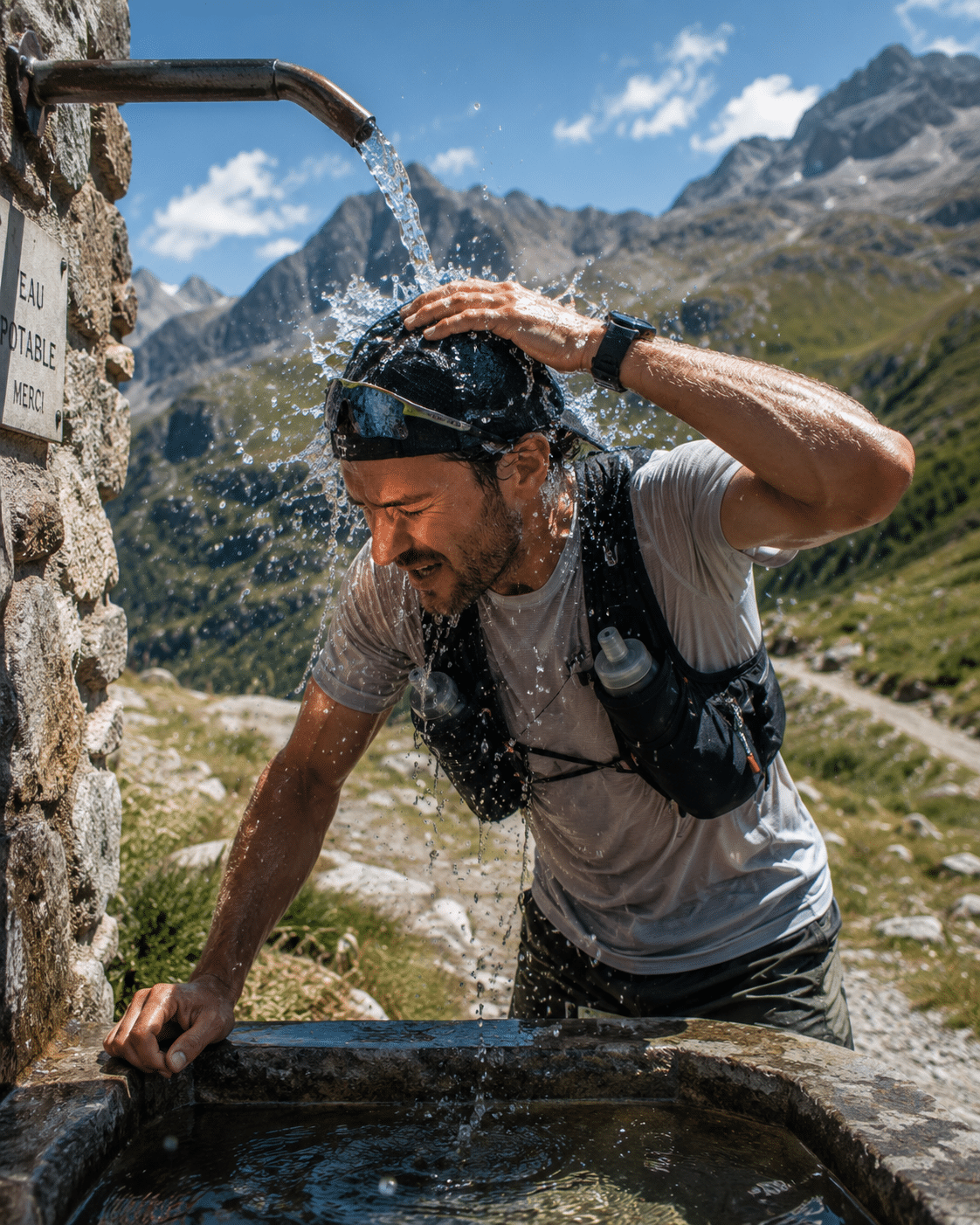
When aid stations provide water, use some of it on your head, neck, arms and cap. If ice is available, use it. Mountain fountains, streams and shaded sections can become valuable cooling opportunities.
The runners who manage body temperature best often perform better than those who simply drink the most.
3. Start Fueling Earlier Than Usual
Heat often reduces appetite.
Unfortunately, your energy needs don’t disappear.
Many runners gradually stop eating without realizing it, only to experience a major energy crash later in the race.
Start fueling early and maintain a regular intake schedule.
If solid food becomes difficult to tolerate, liquid calories can be a useful alternative.
4. Use Shade Strategically
A shaded forest section can feel dramatically cooler than an exposed ridgeline.
Whenever possible, use shaded sections to reduce effort, lower your heart rate and cool down before the next exposed climb.
A few minutes of reduced heat exposure can have a bigger impact than many runners realize.
5. Adapt Your Race Goals
A race run in 30°C, 35°C or higher is not the same race.
Comparing your splits to previous editions or chasing a specific finishing time may become unrealistic.
Experienced runners adapt their expectations to the conditions.
Sometimes a smart race means slowing down early and finishing strong.
6. Recognize the Warning Signs
Heat-related problems rarely appear suddenly.
Warning signs may include:
- Unusually high heart rate
- Chills or goosebumps despite the heat
- Dizziness
- Nausea
- Confusion
- Loss of coordination
If these symptoms appear, slow down immediately and seek cooling opportunities.
No result is worth risking your health.
7. Respect Race Organization Decisions
When race directors shorten a course, modify aid station plans or cancel an event, the decision is rarely taken lightly.
Trail running celebrates resilience and toughness, but organizers must also consider participant safety, volunteers, medical resources and rescue capabilities.
A hot-weather race can create physiological stress far beyond what the distance alone suggests.
Adapting the course does not necessarily make the challenge easier.
It often makes it safer.
Key adjustments for trail running in hot weather
| Adjustment | Why it matters | Practical action |
|---|---|---|
| Forget your usual pace | Heat raises heart rate and makes normal paces harder to sustain. | Run by effort, power hike earlier and accept slower splits. |
| Cool the body | Cooling helps reduce heat accumulation, not just thirst. | Pour water on your head, neck and arms; use ice when available. |
| Start fueling earlier | Heat often reduces appetite, increasing the risk of energy crashes. | Eat or drink calories from the early stages of the race. |
| Use shade strategically | Shaded sections can lower perceived effort and reduce heat exposure. | Ease off in exposed areas and recover slightly in shaded sections. |
| Adapt your race goals | Hot races are physiologically different from cool races. | Adjust finish-time expectations and prioritize a strong finish. |
| Recognize warning signs | Heat-related problems can become serious quickly. | Slow down or stop if you feel dizzy, nauseous, confused or uncoordinated. |
| Respect race decisions | Organizers modify races to protect runners, volunteers and medical teams. | Accept course changes as safety measures, not as a weaker challenge. |
Final Thoughts
Running in hot weather is not about being tougher than the heat.
It’s about adapting better than the heat.
The most successful trail runners are rarely the ones who ignore the conditions. They’re the ones who recognize them early, adjust their strategy and keep making smart decisions throughout the race.
When temperatures rise, experience matters.
And experience usually starts with adaptation.
Frequently Asked Questions About Trail Running in Hot Weather
-
Is it safe to run trails in hot weather?
In many cases, yes - provided you adapt your pace, hydration, fueling and cooling strategy.
However, safety depends on several factors including temperature, humidity, exposure to the sun, elevation gain, race duration and your level of heat acclimatization.
If you experience dizziness, confusion, nausea or chills despite the heat, stop and seek cooling immediately.
-
How much should trail runners drink in hot conditions?
There is no universal answer.
Sweat rates vary significantly between runners and conditions.
Rather than following a fixed number, experienced runners focus on drinking consistently throughout the race while paying attention to thirst, aid station spacing and electrolyte intake.
Overdrinking can be just as problematic as underdrinking.
-
Should I slow down during a hot trail race?
In most cases, yes.
Hot weather increases cardiovascular stress and raises heart rate for the same level of effort.
Many experienced trail runners reduce intensity early, especially on climbs, to avoid overheating later in the race.
A slower start often leads to a stronger finish.
-
How do experienced trail runners stay cool during races?
Beyond hydration, many runners actively cool their bodies throughout the race.
Common strategies include:
- Pouring water over the head and neck
- Using ice under a cap or buff
- Cooling at fountains and streams
- Taking advantage of shaded sections
- Reducing effort on exposed climbs
The goal is not only to replace fluids, but also to limit heat accumulation.
-
Can you train for running in hot weather?
Yes.
Heat acclimatization is a well-established process that helps the body become more efficient at regulating temperature.
Many runners gradually increase exposure to warm conditions during training in the weeks before a race.
Like altitude adaptation, heat adaptation takes time and cannot be fully achieved the day before an event.
-
Why are trail races sometimes shortened or cancelled because of heat?
Race organizers must consider participant safety, medical resources and evacuation capabilities.
When temperatures become exceptionally high, the physiological stress on runners increases significantly, especially on long and exposed courses.
Course modifications and cancellations are often implemented to reduce risk rather than reduce the challenge.