With the increasing popularity of trail running in Europe,
the cost of registering for these races has become a significant consideration
for runners. As many athletes plan their race calendar, understanding the
differences in registration fees across countries and events can help them make
informed decisions. In this article, we present a comprehensive analysis of
registration fees for some of the most famous trail races in Europe, comparing
them with the well-known UTMB series.
Methodology
This study examines the average registration fees for over
60 major trail races across various European countries. The selection includes
renowned events such as the Madeira Island Ultra Trail (MIUT) in Portugal,
Transgrancanaria and Transvulcania in Spain, Maxi Race and Grand Raid des
Pyrénées in France, Adamello and Tor des Géants in Italy, and the Salomon Pitz
Alpine Glacier Trail in Austria. By focusing exclusively on large, famous
races, we aimed to provide a meaningful comparison with UTMB races, which are
known for their prestige and higher entry costs.
For each race, where multiple pricing options were available
(e.g., early bird rates), the average price was used. To standardize the
analysis, race distances were rounded to common categories, with a tolerance of
+/- 5km. Intermediate distances such as 30k, 60k, or 80k were not included in
the study. It is also important to note that smaller, local races, which
generally have lower registration fees, were excluded to ensure the comparison
remained between events of similar stature.
Key Findings
1. UTMB Races: A Premium Price Tag The study reveals
that UTMB-branded races are significantly more expensive than other major trail
events in Europe, particularly for shorter distances such as half marathons and
marathons. In some cases, the registration fees for these shorter UTMB events
can be nearly double, or even more, compared to other famous races.
2. Regional Variations: Spain, France, Italy, Portugal,
and Austria
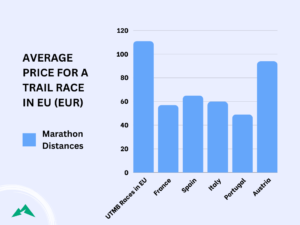
- Spain, France, and Italy: The average registration prices for prominent races in these countries are relatively consistent, with only minor differences.
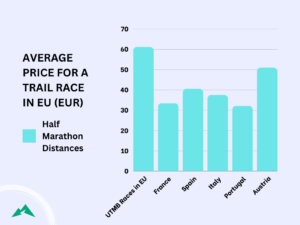
- For example, half marathon registration fees in France and Portugal
generally hover just above €30, while UTMB events charge over €60. - Portugal:
Across all race distances, Portugal consistently offers the lowest
registration fees, with marathon events typically costing under €50 on
average. - Austria:
In contrast, Austria emerges as the most expensive country for trail race
registrations, with consistently higher prices across all distances.
3. Distance-Related Pricing: A Closer Look
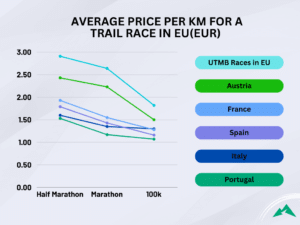
Interestingly, the cost difference per kilometer is more pronounced for shorter
distances. For instance, half marathon fees in Portugal are just over €30,
while similar UTMB events cost more than €60. Marathon distances also show
significant variation, with Portuguese races charging under €50 compared to
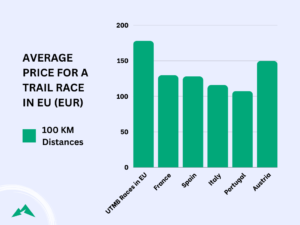
over €100 for UTMB events. However, as race distances increase, the price gap
narrows. For 100k races, registration fees range from just under €110 in
Portugal to just under €180 for UTMB events.
Considerations
It’s important to recognize that registration fees can
include different items depending on the race. Some races might offer more
comprehensive packages, including equipment, food, and refreshments, while
others might offer fewer inclusions. Therefore, while this study provides an
average comparison across various races and countries, the differences in what
is included should be considered when evaluating these prices.
This analysis serves as a useful guide for runners looking
to plan their next trail adventure, helping them navigate the often confusing
landscape of race registration fees. Whether you’re seeking a more affordable
option or considering a UTMB event for the prestige, this study tries to offer
valuable insights to help you make the best decision for your trail running
goals.
Gongga 100: What Is It Really Like to Race in China’s High Mountains?
How much does it cost to enter a trail race in Europe? TrailRunAdvisor analysed 200+ races across 11 countries to compare entry fees across half marathon, marathon, 100K and 100-mile distances, including UTMB® World Series races.
Western States Qualifying Races 2027 & 2028: New Races, Changes and Entry Process
The Western States Endurance Run has released its qualifying race lists for the 2027 and 2028 lotteries. Here are the biggest changes, the new qualifying races to know about, and how the Western States lottery entry process works. For thousands of ultrarunners around the world, getting into the Western States Endurance Run is a long-term goal. The 100-mile race from Olympic Valley to Auburn is one of the most sought-after races in trail running, and for most runners, the first step is completing an official Western States qualifying race. The Western States Endurance Run (WSER) has now published its qualifying race lists for both the 2027 and 2028 lotteries, giving runners a much clearer picture of their options for the next two years. How the
5 Ultra Trail Races in Spain You Should Discover
Photo credit: UltraMediterrania Instagram Spain is one of Europe’s most exciting destinations for trail running and ultra trail racing. From the mountains of Andalucía and the Sierra de Guadarrama to the Mediterranean ranges of Alicante and the spectacular valleys of Málaga, ultra trail races in Spain offer an extraordinary variety of terrain, landscapes and challenges. For international runners, however, the Spanish ultra trail calendar can be surprisingly difficult to navigate. Beyond the biggest names in the sport, there are dozens of races offering spectacular courses, strong local identities and very different ways to experience Spain on foot. And if you are searching specifically for a 100K ultra in Spain, there are plenty of options beyond the most famous international races. So, whether you are looking
Ticino 500: What It’s Really Like to Run 500 km and 40,000m of Elevation
500 km. 40,000 metres of elevation gain. Almost no sleep. A backpack weighing up to 12 kg. And, at one point, around 20 km without water. What does it actually feel like to take on a trail race of this magnitude? After 150 km, Alessandro spent around 20 km without water under the midday sun. During the first 36 hours, he slept for just seven minutes. His backpack reached 12 kg, and with aid stations around 50 km apart, managing hydration and food became a challenge in itself. Alessandro’s previous longest race was the Tor130. The jump to 500 km was therefore not a gradual progression. It was, in his own words, a “leap into the void.” We spoke to Alessandro after completing the Ticino