
Winter Spine Race: Antonio Codina on Finishing One of the Toughest Ultra Races in the World
The Winter Spine Race is widely regarded as one of the toughest ultra-trail races in the world. Covering 268 miles along the Pennine Way, in the heart of a British winter, it demands total self-sufficiency, navigation skills, resilience to cold, darkness, sleep deprivation, and the ability to keep moving when conditions become truly extreme.
Finishing the Winter Spine Race 2025 is not simply a sporting result — it is a profound physical and psychological achievement.
In this interview, we speak with Antonio Codina, a multiple-time Winter Spine Race finisher, who has completed both the Challenger and the full 268-mile race across several editions, including Spine Race 2025. Drawing on years of experience, Antonio shares what it really takes to survive one of the world’s most demanding ultra-distance events.
From training and preparation, gear selection, nutrition in extreme cold, and sleep deprivation management, to the mental strategies required to endure days of continuous effort, Antonio offers an honest and practical insight into life inside the Winter Spine Race.
Whether you are preparing for the Spine yourself, considering expedition-style ultra races, or following athletes who will take on the Winter Spine Race in January, this interview provides valuable lessons from someone who knows the race from the inside.
Q1 The Winter Spine Race is known as one of the toughest in the world.
What was the moment during the race when you realized its true difficulty, and how did you mentally push through it?
It has happened many times over the years, because I have taken part 4 times in Winter Spine races. In 2019 and 2023 I took part in the Challenger South, and in 2020 and 2025 in the full distance of 268 miles. During the 2019 Spine challenger south, I totally underestimated it thinking that it was only a 100 mile race and I finished like a broken man. I did not realise how slow you move on that course, with a heavy pack and mostly in the dark. I sleepwalked for hours like a zombie. My thought right after was, how do I have to run the first 100 miles to continue until the end? I came back in 2020 on the full race and finished despite getting a calf injury early on the race. I was better prepared mentally, I started slower and used micro naps to power me along the way. When I got injured I adapted to it, slowing down and doing one checkpoint at a time. This year I came back even better prepared and I knocked down nearly 12 hours from my 2020 time.
Q2 Preparation is key for a race of this magnitude.
Looking back, what part of your training proved to be the most essential, and is there anything you would prepare differently now?
From the physical point of view I do strength exercises and train with the backpack. You want to train your lower leg muscles a lot as most people end up with strain injuries in their calves and shins from sliding in the mud all the time. I would work even more on that aspect because I have always finished with serious strain in my lower legs muscles.
Long days out with your kit are essential too. You want to be confident being out there on your own on all weathers.
Q3 Gear can make or break the Spine Race experience.
What were the three most valuable pieces of equipment you carried, and what gear mistakes should one avoid at all costs?
I suffer from cold hands and I use goretex overmitts from Extremities. I have attached strings to them so I can remove them without losing them. If my hands are cold I just put them on top of my wet gloves and my hands warm up in no time.
Your rain jacket is another essential piece of kit. Avoid very light jackets because they will not protect you from the rain and wind that you can get in winter out there. Ideally you want to have with vents under your arms so you can cool down without removing your jacket and backpack to minimise faffing. It’s quite controversial but I love paramo jackets. They do not pass kit check but I am certain that they will keep me dry in the worse storm.
Finally and one of the most important, you want to find out the sock shoe combination that you want to use. Most people use waterproof socks, but they are not for everyone. And your favourite shoes may not fit with them, as I found last year. My favourite socks are the dexshell compression mudder (they may have changed name now)
OK, I know you only want three pieces of gear but I must add a forth. The Inov8 hybrid jacket is an amazing piece of kit, warm, light and dries very fast. I wore it almost every day during last year’s race.
Q4 Weather and terrain are extremely unpredictable.
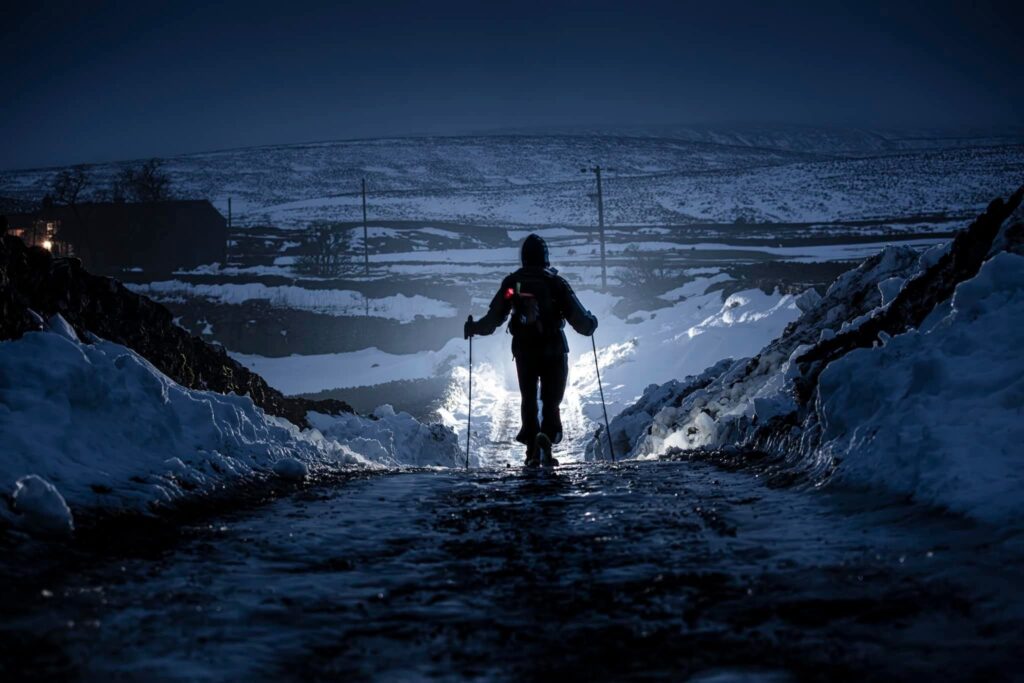
How did you manage long periods of cold, wind, and darkness? Any specific strategies to stay warm, dry, and safe throughout the nights?
Always have a spare layer in your bag when you leave a checkpoint! And think ahead. If you are about to cross over a high and exposed area you may want to put something warmer before.
In very tricky situations you may want to team up with a fellow runners. This last year, navigating huge snow drifts in the middle of a storm I was glad to work with Andrew Heaney to help each other with the navigation.
Have your spare headtorch ready to use in case your main one fails. And charge your lights in the checkpoints because you don’t want to spend time changing batteries under the rain.
Q5 Sleep and fatigue management are critical.
How did you balance the need to progress with the need to rest, and what is your advice for avoiding the “sleep-deprivation spiral”?
Your sleep strategy is very important, you want to study the route and know the possible rest points between the checkpoints. There are a few sheltered places between checkpoints where you can sleep or just rest hiding from the weather. You should make a list of them and know what your options are depending on how you are feeling or the weather as you pass through. Micro naps of 15 minutes work very well for me, so I sleep about 3 hours in the checkpoints and then catch microsleeps in between. You need to find out what works for you though.
Q6 The Spine Race is often described as more psychological than physical.
What mental tools or techniques helped you stay focused when things became really tough?
In really tough moments I just think of the task in hand, which is getting to the next checkpoint or sheltered place. I always think how lucky I am that I can do this race. In the hardest moments I often think “where would you rather be?” And the answer always is “nowhere else”
Q7 Nutrition becomes incredibly challenging in such cold and long races.
What was your fuelling strategy during the Spine Race - both in terms of what you ate and how often - and what advice would you give to avoid energy crashes or stomach issues in those conditions?
I eat all the time! My bag is full of bars and gels to keep me going, also nuts or savoury snacks to add variety. People think gels are not useful on a race of this length but they can be very fast to take, even with gloves to give you a quick boost.
For the longest sections I pack a dehydrated meal that I prepare with water from my thermos, places like the small checkpoint of Malham Tarn also supply hot water. I always find that a warm meal keeps me going much longer than if I am just snacking on trail food. The food in the checkpoints is excellent and I always make the most of it too.
I am a Mountain Fuel embassador so always have energy drinks in my bottles to help with the calory intake and also to stop them from freezing when is very cold.
Q8 You’ve completed other major ultra-trail events.
How does the Winter Spine Race compare to the other ultras you’ve done in terms of difficulty, terrain, mindset, and overall experience?
Each race is a different challenge, and they can be difficult to compare. I often say that when compared to Tor des Geants or Dragons Back the Spine Race is the hardest race, mostly because it’s not marked, you have way less support and have to carry a lot of gear, and the weather and terrain are totally unpredictable. I don’t exaggerate when I say that in some situations you will be in shock. The experience is unique, not just for how hard race is but because of the army of volunteers that will do everything to help you. There is an immense positivity the full week that is just fantastic. A group of runners set off to attempt something extraordinary, and all those volunteers give away their time for you to do it.
Q9 For someone preparing for the upcoming edition…
If you could give him one single piece of advice to finish the Winter Spine Race, what would it be?
Just one? Get out in horrible weather to test your gear, your navigation and have confidence in your ability. Connect with past participants to learn from them, everyone is very friendly and we are a fantastic Spine family. Look after yourself, it’s very easy to catch a bad cold at this time of the year and ruin your race. And smile because you are likely to have one of the best adventures of your life.
Conclusion
Antonio Codina’s journey through the Winter Spine Race highlights what truly defines this legendary ultra: adaptability, patience, and respect for the environment. Through experience, refined preparation, and hard-earned lessons, he transformed early suffering into control — improving his performance by nearly 12 hours between editions.
More than any single physical challenge, the Spine Race is a mental test. Breaking the race into manageable sections, mastering sleep deprivation, fuelling consistently in extreme cold, and trusting your equipment are all essential elements for success over 268 miles.
As Antonio explains, the Winter Spine Race is also unique for its spirit: a rare combination of brutal conditions, personal limits, and an extraordinary community of runners and volunteers. It is an ultra-trail event where finishing matters far more than ranking.
For future participants , Antonio’s experience offers concrete advice, realistic expectations, and a powerful reminder: in the harshest races on earth, preparation, humility, and mental resilience are what carry you to the finish line.